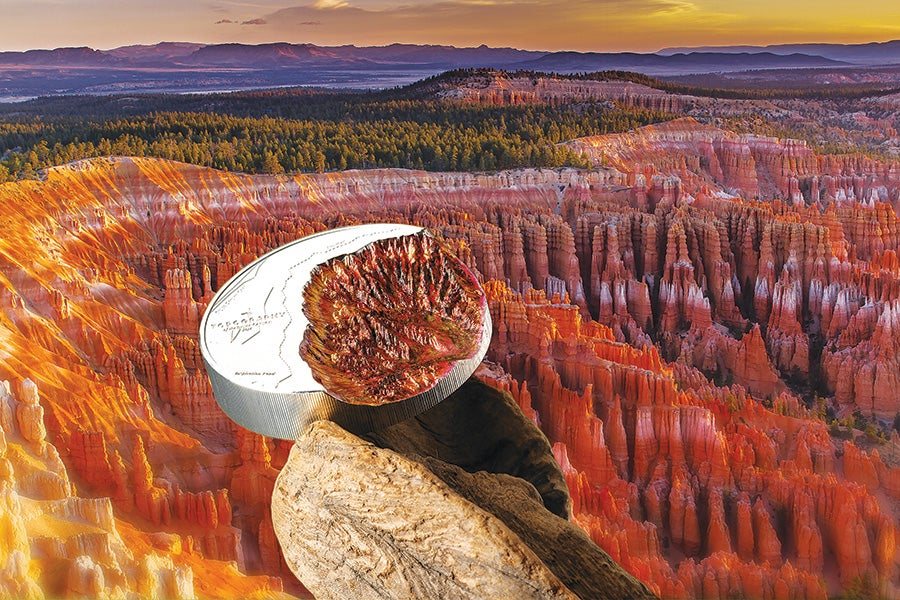
For its Summer collection, CIT released a 5-ounce, $25 silver coin for the Cook Islands that honors the National Park, Bryce Canyon, located in Utah. The coin recreates the Canyon with an aerial perspective looking down at a three-dimensional, colorized design.
Bryce Canyon is not, in fact, a “canyon”, but a group of natural amphitheaters formed by headward erosion of a southeastern portion of the Paunsaugunt Plateau millions of years ago. This erosion, along with precipitation and a process called “ice wedging,” formed thousands of “hoodoos,” distinctive, multilayered, column-shaped geologic formations. Bryce Canyon has the largest collection of hoodoos in the world, which attracts millions of tourists each year.
Bryce Canyon was named for Ebenezer Bryce, a Mormon settler who emigrated from Scotland to Utah in the mid-nineteenth century. He settled near the canyon that bears his name around 1875. His work building infrastructure through the Paria Valley attached his name to the region, though his time in the area was short-lived. Bryce moved to the Upper Gila River region of Arizona in 1880, and the town of Bryce, Arizona, bears his name.
Large numbers of tourists began visiting Bryce Canyon in the first decades of the twentieth century. It was established as a National Monument in 1923 and a National Park in 1928.
The coin is a part of CIT’s “Topography” series, which initially launched in 2023 with 5-ounce and kilogram-weight silver coins honoring the Grand Canyon. Along with the Grand Canyon, all coins thus far have honored locations in the United States, including Hawaii and Yellowstone.
All “Topography” coins recreate their site’s famous geological features with three-dimensional, incuse designs. On the Bryce Canyon issue, the canyon wall descends from roughly the coin’s reverse midpoint to the viewer’s right, ending at the coin’s edge. Like the other coins in the series, the Bryce Canyon coin is selectively colorized, with the entire three-dimensional canyon in color.
The rest of the coin’s reverse is struck more traditionally, with a relief depiction of a topographical map of the canyon, and incuse legends reading, “TOPOGRAPHY / of the Bryce Canyon / 2026.”
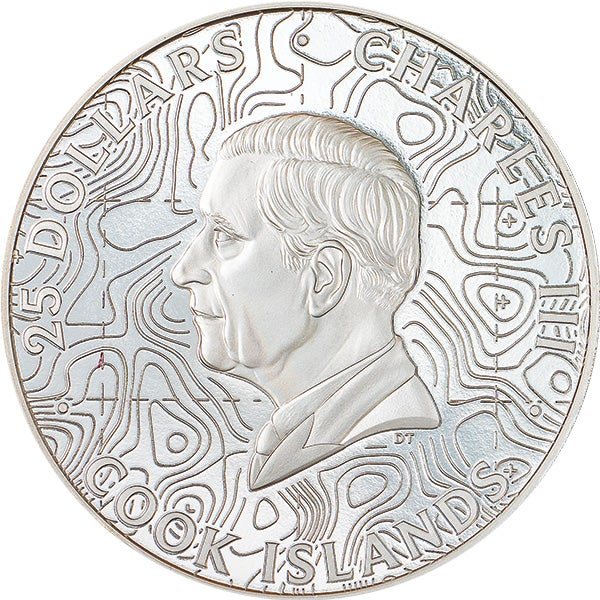
The coin’s obverse bears Dan Thorne’s profile of King Charles III with legends stating the issuing authority, denomination, and Charles’ name. Stylized elements in the obverse fields resemble the lines of a topographical map. The obverse is in relief.
The coin is composed of .9999 fine silver and weighs 5 ounces. It measures 50mm in diameter, has a reeded edge, and a mintage limited to 777 pieces. The coin is issued with a presentation box with a photograph of Bryce Canyon and a certificate of authenticity.
Source: Numismatic News