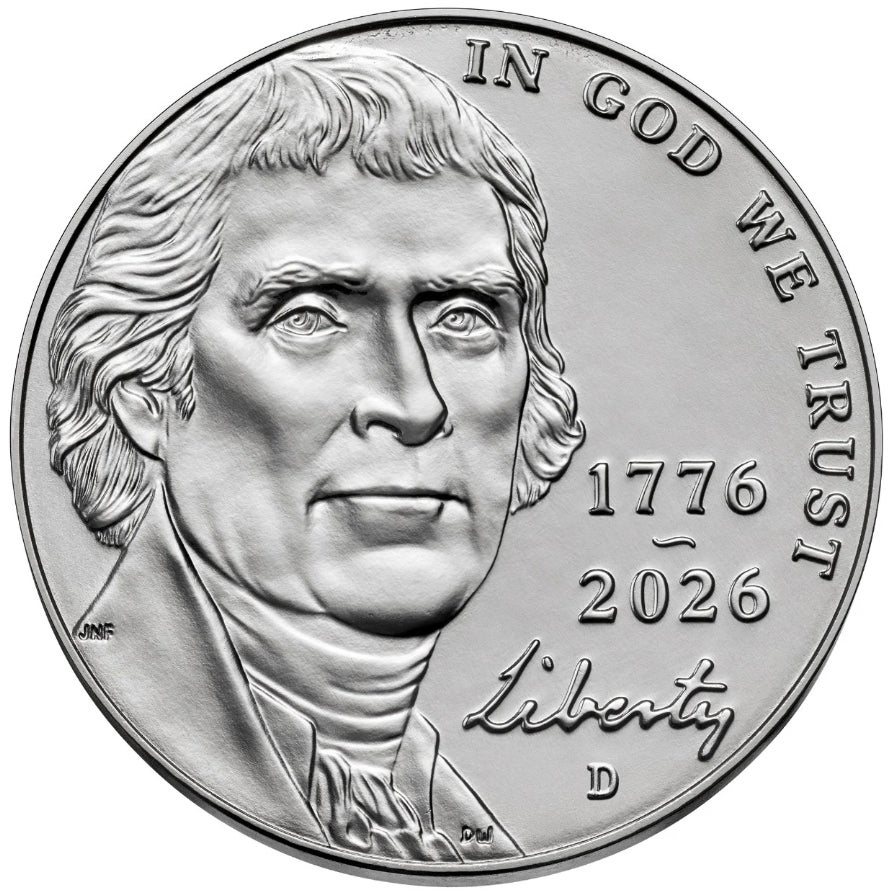
Tuesday of last week, the intrinsic value of the metal content of a Jefferson Nickel was just under 7-1/2 cents. When you add the costs of labor and overhead to mint them, the total cost exceeds 10 cents each.
Why should the U.S. Mint continue to strike these coins when it is taking a loss on every one struck? With a mintage for circulation of more than 1.04 billion of these coins last year, that indicates a total loss of more than $52 million.
Changing a nation’s monetary system involves more than looking at the cost to strike coins or print currency.
When the U.S. Mint switched from striking Lincoln Cents in 1982 that had been made of 95 percent copper and 5 percent zinc to 97.5 percent zinc and 2.5 percent copper, there weren’t any widespread objections. That was because the appearance, the size, and the exterior of the cent looked the same. The vending machine industry had little difficulty making adjustments.
When the Mint ceased production of cents for circulation last year, there was more of an outcry. However, there were ample supplies of cents in circulation. Over 540 billion Lincoln cents had been struck for circulation since 1909, meaning more than 1,500 coins per capita.
When the Mint stopped producing 95 percent copper cents in 1982, some people began hoarding them for the metal value, which as of last week exceeded four cents. When it was announced in 2025 that no more cents would be issued for circulation, even more people started hoarding all cents in the hope they might someday become rare collectibles. Still, there is no shortage of cents already in circulation.
Also, there was little resistance because the one-cent denomination had ceased to be economically viable (as happened with the half cent in 1857). Previously, nations such as Australia, Bahamas, Brazil, Canada, Cook Islands, New Zealand, and Sweden had ceased production of cent or cent-equivalent coins. Many Americans are aware that Canada had withdrawn cents from circulation, so last year’s halt in U.S. cent production wasn’t that big of a shock.
Nickels have a larger economic value. No nation that I know of has discontinued striking coins of this much purchasing power. Therefore, if the U.S. were to stop minting nickels, it would be the first country to do so.
If you look at the political aspects of striking nickels for circulation, doing so would highlight the loss in purchasing power of the U.S. dollar. This would be compounded coming so soon after the end of cent production. Incumbent politicians would not want the public to become more aware of this loss.
If you consider everyday commerce, the discontinuation of the nickel would push cash transactions to possibly being rounded to the nearest ten cents.
There are also more than 70 billion Jefferson nickels struck for circulation, about 200 per capita, meaning more than $3.5 billion in potential lost purchasing power.
You would also have a larger problem for the vending machine industry to modify their equipment for the cessation of circulating nickels.
The options for the U.S. Treasury would be to find another alloy to strike nickels that would cost less than five cents to produce, or to half future production. It might be possible to manufacture a lightweight aluminum five-cent coin for less than face value, but the public would likely have some objections and the vending machine industry would also complain.
There has not yet been as much advocacy for ending the minting of U.S. nickels as there was for cents. Although halting production might not happen for a few years, expect the discussion to become more extensive as time goes on.
Last column’s numismatic trivia question
Last time I asked, what are the components of the “paper” of U.S. currency? U.S. currency is not made from paper, which is manufactured from wood pulp. Instead, it is made of 75 percent cotton and 25 percent linen (from the bast fibers of flax). This content is built to endure about 4,000 double folds before breaking.
This column’s trivia question
Here is this column’s question. Which U.S. coins had an official metal value equal to face value at the time they were struck? Come back next week for the answer.
Patrick A. Heller was honored as a 2019 FUN Numismatic Ambassador. He is also the recipient of the American Numismatic Association 2018 Glenn Smedley Memorial Service Award, the 2017 Exemplary Service Award, the 2012 Harry Forman National Dealer of the Year Award, and the 2008 Presidential Award. Over the years, he has also been honored by the Numismatic Literary Guild, Professional Numismatists Guild, National Coin & Bullion Association, and the Michigan State Numismatic Society. He is the communications officer of Liberty Coin Service in Lansing, Michigan, and writes “Liberty’s Outlook,” a quarterly newsletter on rare coins and precious metals subjects. He now volunteers with the National Coin & Bullion Association as its Industry Issues Advisor. Past newsletter issues can be viewed at www.libertycoinservice.com. Some of his radio commentaries, “Things You ‘Know’ That Just Aren’t So,” and “Important News You Need To Know,” can be heard at 8:45 a.m. Wednesday and Friday mornings on 1320-AM WILS in Lansing (which streams live and becomes part of the audio archives posted at www.1320wils.com).
Source: Numismatic News