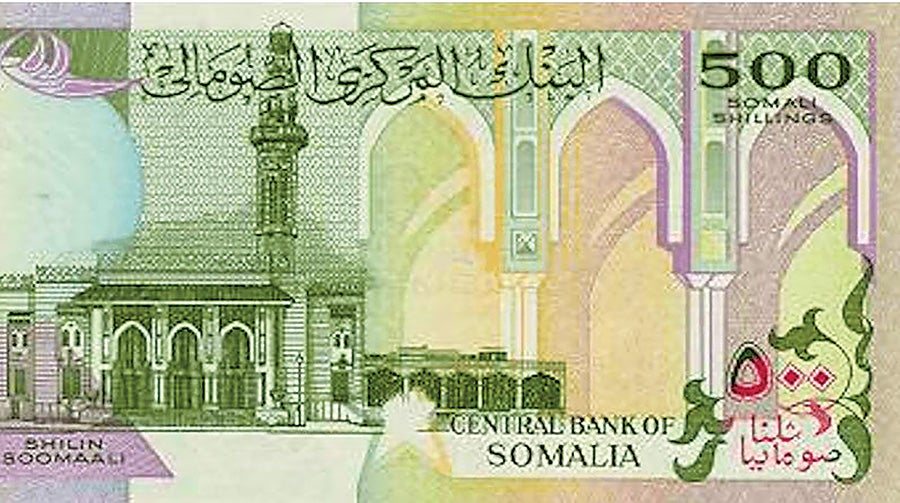
The dollar bill is estimated to last about six years in circulation. Can you imagine what a bank note would look like if it had to last for 35 years? That is the predicament that has happened in Somalia.
The nation, which stretches across the Horn of Africa, suffered through a civil war between 1991 and 2006. The insurgency that followed the establishment of the Transitional Federal Government of Somalia continued through 2012. The constant warfare left Somalia as being one of the least developed nations on earth.
Currently, there is a Federal Government of Somalia, but insurgents continue to control parts of the beleaguered nation. Livestock and US currency function as money alongside 35-year-old Somali banknotes that are now increasingly being refused by merchants due to their ragged condition. So, why doesn’t Somalia simply arrange to have fresh banknotes printed?
The transitional government revived the defunct Central Bank of Somalia during the late 2000s. A lack of confidence in the Somali shilling and the release of the few notes that were available inadvertently fueled inflation, and the dollarization of the economy followed. Somalia residents living abroad encouraged dollarization via sending U.S. currency home through money transfer networks.
Adding to this confusion, Somaliland declared its independence and, since 1994, has been issuing its own shilling currency. Somaliland is not recognized internationally; however, the region continues to use its own coins and bank notes. Due to inflation, the 100-, 500-, 1,000-, and 5,000-shilin bank notes are the only denominations reported to be in circulation. These notes are dated through 2011. The breakaway government planned to issue notes in 2017 and 2022; however, none were able to be verified at the time this article was being written.
As for Somalia, a 2017 International Monetary Fund report indicated a staggering 98% of Somalia bank notes in circulation were counterfeit. Transparency is a problem. Sources indicate bank notes in denominations of 1,000, 2,000, 10,000, 20,000, and 50,000 shillings were printed in Sudan. In 2022, former bank governor Abdisalan Omer Hadliye said bank notes were “lying idly” in a Sudanese warehouse, but the notes had been printed by an unnamed German company. There have been continual promises of a new currency, yet none has been reported to date.
Through mid-2026, Somalia’s inflation was as high as 9.34%, partially influenced by the increased conflict going on in the Middle East involving Iran and the United States.
Currently, Somalia’s parliament is considering a Currency Board Arrangement, finalizing bank reserve management, and regulations regarding foreign exchange. No announcement has been made regarding whether newly designed notes would be issued, and if so, who would print them.
According to Somalia Commerce Minister Gamal (Jamal) Mohamed Hassan, “There is a process underway to get new banknotes,” continuing that the central bank has made “issuing a viable national currency and strengthening monetary policy tools” a priority.
The Somalia government and central bank are under immense pressure to get a form of domestic currency into circulation. In 2027, the United States will cease supporting United Nations logistical backing for the nearly 12,000-strong African Union Support and Stabilization Mission in Somalia. This will impact the nation’s ability to obtain food, fuel, medical services, and troop transport. In addition, an estimated 1,100 Somalis living in the United States, many of whom have been sending dollars home via electronic systems, may be deported in the near future.
On September 2, Central Bank Governor Abdirahman Mohamed Abdullahi said, “We cannot have a monetary policy without reintroducing the Somali shilling…issuing a viable national currency and strengthening monetary policy tools is a strategic priority.”
Source: Numismatic News